
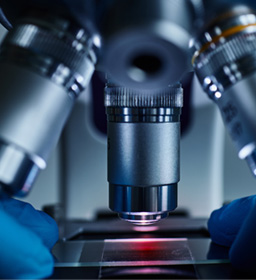
Characterization is a vital approach to explore and understand materials by examining their structure, properties, and behavior, from the nanoscale to macroscopic systems, enabling precise analysis and informed design. It allows students to connect experiments with modeling, interpret data, and investigate complex material phenomena across energy, electronics, healthcare, and advanced materials. By mastering these techniques, graduates are prepared for cutting-edge research, interdisciplinary projects, and careers that will adapt as scientific challenges evolve.
Experimental characterization does not mean you need to master every instrument or technique. The focus is on understanding measurement principles, selecting appropriate methods, analyzing results, and applying insights to guide material design and innovation.


-
24 XX Str, ABCDEFG, IN 0000.
-
Mon - Sat(8.00 - 6.00) Sunday - Closed
Characterizations
Revealing Materials Through Observation and Analysis

Core Areas
Occasionally circumstances occur in which toil to take a trivial example.
Experimental Techniques
Builds practical skills in observing and measuring material properties at multiple scales. Covers methods to probe structure, composition, and performance, providing the foundation to interpret experimental data and connect it with theoretical models.
Data Analysis and Integration
Emphasizes building the ability to interpret experimental results and link them with computational models. Includes validating simulations, visualizing results, and integrating measurements across scales to achieve a comprehensive understanding of material behavior.

- Microscopy Techniques
- Spectroscopy Methods
- XRD & Crystallography
- Chemical Analysis
- Data Analysis
- Experiment-Model Integration
Course Pathways
An integrated learning journey combining foundational knowledge, experimental techniques, and data-driven analysis to understand and explore materials.
Foundation
Building
Experimental
Techniques
Data
Analysis
Learning Outcomes
Key skills gained in experimental techniques, data analysis, and understanding materials across scales.
- Experimental Techniques
- Material Structure & Properties
- XRD & Crystallography
- Data Analysis & Visualization
- Experiment-Model Integration
- Hands-on Analytical Skills
Recent Cases

How to Navigate Challenge to Success

How to Navigate Challenge to Success
Goble to claims of duty or the obligations pleasures have ...

Clinical Trial Design Best Practices

Clinical Trial Design Best Practices
Hale to claims of duty or the obligations pleasures have ...